
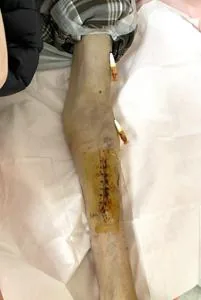
Photo: This patient had forearm access surgery and the new access could not be needled yet. To spare the patient a central venous catheter, with its inconvenience, risk of infection and risk of central vein stenosis, we cannulated with soft needles so that every dialysis session could be completed. Soft needles were chosen for two reasons: (1) the arterial needle sits near the elbow joint, where a sharp metal needle raises the risk of piercing through the vessel; (2) the venous needle goes into an upper-arm vein that is thin and fragile, so if the patient moved their arm a sharp needle could puncture it and cause a hematoma.
Few staff in Taiwan today fully understand the structure, characteristics and limits of soft hemodialysis needles or have much experience with them. Hui Der Clinic knows soft needles well and uses them extensively. Some common misconceptions: (1) They are awkward to use and only suit easy accesses? At Hui Der Clinic soft needles are used routinely as needed, without difficulty, mainly for difficult accesses that are thin, fragile, curved or deep. (2) Soft needles cannot be repositioned? This is a mistaken assumption; they can be adjusted, and Dr. Han has extensive experience doing so. (3) Soft needles are too long? Every patient's access is different, so we need a range of equipment and techniques to match each one. Some deep or curved accesses need a longer soft needle. Without that option, a deep access may be unreachable or a curved one easily pierced by a sharp needle, leaving only a catheter or surgery for a new access. That wastes a usable vessel and adds to the patient's burden.